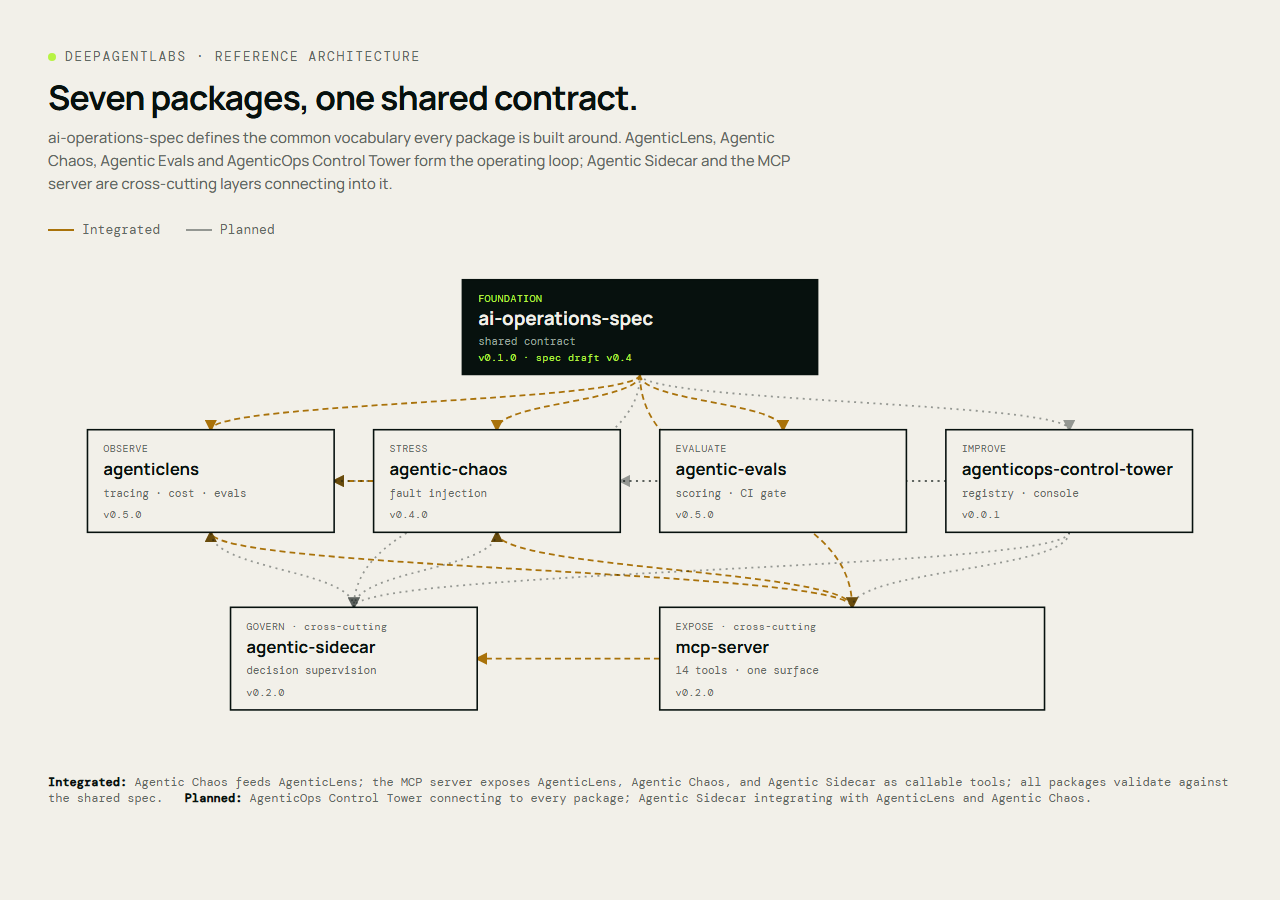
AI Operations Specificationv0.4 draft
The vendor-neutral contract for runs, steps, model/tool calls, evaluations, and incidents — the shared vocabulary every tool on this page implements, not an SDK or a runtime itself.
What it defines
- Runs, steps & incidents schema
- Model & tool call vocabulary
- Evaluation & safety signals
- JSON Schema artifacts, v0.1–v0.4
- schema_valid
- semantic_valid
- aligned: true
Conformance check example: schema valid, semantic valid, aligned true.
One shared contract every framework below can validate against.
AgenticLensworkflow profile
OpenTelemetry-native observability for production AI: ingest OTLP traces, track cost and latency per run, and surface evidence-backed findings for where to cut waste.
Capabilities
- OTLP trace ingestion
- Cost & token tracking
- Latency (p50/p95) breakdown
- Built-in evaluation engine
- Pass/fail release gates
- Cost-cutting recommendations
$0.041avg cost / run
412msp95 latency
6findings
Cost per run trending down across five recent runs, from $0.087 to $0.041, alongside six optimization findings.
Cost trending down over five runs after acting on its own findings.
Agentic Evalsrelease gate
Framework-agnostic scoring for any trace-shaped run — deterministic checks, rubric scorers, and LLM-as-judge evaluators, wired into a pass/fail gate you drop into CI.
Capabilities
- Deterministic scorers (exact/regex/JSON diff)
- 10 built-in LLM-judge rubrics
- Trajectory & tool-call scorers
- One-line
Eval() quickstart API
- Declarative TestSuite/TestCase API
- CI release gate + CLI
- trajectory-quality ≥ 0.850.91
- cost-per-run ≤ $0.05$0.031
- hallucination-rate ≤ 2%1.8%
Release gate: trajectory quality 0.91 passes an 0.85 threshold, cost per run $0.031 passes a $0.05 cap, hallucination rate 1.8% sits inside a 2% warning band.
Three thresholds, one CI gate — the merge blocks until every run clears them.
Agentic Chaos120 injected faults
Fault injection and topology-aware drift testing across agent frameworks — provider failures, corrupted outputs, and tool errors, forced before production does it for you.
Capabilities
- Timeout & rate-limit injection
- Silent output corruption
- Tool & memory faults
- Topology-aware drift detection
- LangGraph fault wrapper
- Standalone JSON chaos report
- Recovered · 68%
- Degraded · 22%
- Failed · 10%
Outcome of 120 injected faults: 68% recovered, 22% degraded, 10% failed.
One in ten injected faults broke the agent outright — before a user hit it.
Agentic Sidecar500 decisions
A real-time Decision Gate that watches an agent's next action against its declared intent — catching moves that are technically permitted but contextually wrong, not just disallowed content.
Capabilities
- Real-time Decision Gate
- Policy Advisor + Risk Evaluator
- Intent Guardian (drift detection)
- Allow / Warn / Block outcomes
- Observe mode & Govern mode
- LangGraph adapter
- Allow · 462
- Warn · 29
- Block · 9
Decision Gate outcomes across 500 actions: 462 allowed, 29 warned, 9 blocked as out of scope.
Escalating intervention, not a failure rate — a block is the Sidecar working.
AgenticOps Control Tower48 agents
The fleet-wide registry and control plane: which agents exist, what's installed, which framework they run on, and what needs attention right now.
Capabilities today
- In-memory agent registry
- Capability discovery
- Heartbeat-based health
- Optional HTTP API & CLI
- Healthy · 41
- Degraded · 5
- Unhealthy · 2
Fleet status across 48 registered agents: 41 healthy, 5 degraded, 2 unhealthy.
One registry for every agent's runtime, framework, and capability versions.
DeepAgent MCPlive surface
A unified MCP interface over the shared model — exposing AgenticLens, Agentic Chaos, Agentic Sidecar, and Spec validation as one set of tools any MCP client can call.
Capabilities
- 14 callable tools
- Wraps Lens, Chaos, Sidecar & Spec
- 2 shared resources
- 3 prompt templates
- stdio transport, session state
- One identity for any MCP client
14tools exposed
1,284calls routed today
4/5adapters connected
14 tools exposed, 1,284 calls routed today, 4 of 5 sibling adapters connected.
One MCP-native surface over every framework above, degrading honestly when one's missing.