v0.5: streaming, provider patches, and profiles
v0.5 preserves the existing ChaosReport / chaos_events JSON contract.
Provider SDKs remain optional: pip install agentic-chaos[providers] installs
OpenAI, Anthropic, and Google Gen AI together; install an individual SDK instead
if you only use one provider. Python 3.10 uses tomli; later versions use tomllib.
Streaming
from agentic_chaos import StreamCutFault, chaos_session, chaos_stream

with chaos_session([StreamCutFault(after_chunks=2)]) as session:
    chunks = list(chaos_stream(iter(["Hello", " world", "!"]), step_name="answer"))
assert chunks == ["Hello", " world"]
| Fault | Parameters | Behavior |
|---|---|---|
StreamCutFault |
after_chunks=1 |
Ends normally after N delivered chunks, without reading ahead |
StreamHangFault |
after_chunks=0, delay_seconds=1 |
Freezes at N chunks, then raises StreamHangError |
SlowTTFTFault |
delay_seconds=1 |
Delays the first delivered chunk |
SlowChunksFault |
delay_seconds=1 |
Delays each delivery after the first chunk |
All accept probability=1.0 and seed=None. Probability is sampled once per
stream. chaos_astream() provides the same behavior for async iterators using
cancellable async sleeps. Stream faults belong on chaos_stream() /
chaos_astream(), rather than chaos_call(). Consume the stream inside the
session, and explicitly close() / aclose() on early abandonment. Wrappers own
and close their source on exhaustion, injected failure, or explicit close.
Cut events use outcome="degraded", hang events "errored", and delay events
"delayed". detail records delivered chunk count, configured cut point, and
delay. Events are emitted when the stream is affected, not when it is created.
Slow faults emit once per stream; empty streams don't produce delay events.
A cut at exactly N chunks still records the configured cut without consuming an
extra chunk to discover whether the upstream stream would have ended naturally.
Hang delays are bounded simulations, not infinite waits or real socket timeouts.
Provider patching
from openai import OpenAI
from agentic_chaos import StreamCutFault, chaos_session, patch_openai

client = OpenAI()
with chaos_session([StreamCutFault(after_chunks=2)]) as session:
    patch_openai(client)
    with client.chat.completions.create(
        model="your-model", messages=[{"role": "user", "content": "Hello"}], stream=True,
    ) as stream:
        for chunk in stream:
            print(chunk)
# Original methods are restored, including when the application raises.
Pass an existing client explicitly. Patches affect that instance and the current
session context. They leave unrelated clients and other contexts alone. A patch
requires an active session and exactly one selected fault. With multiple faults
configured, use patch_openai(client, faults=["stream_cut"]) to select one.
Explicit instances must be the same instances configured in the session.
ProviderPatch.close() allows earlier restoration; repeated close is safe.
Duplicate patches are rejected and partially installed patches are rolled back.
| Helper | Patched SDK methods |
|---|---|
patch_openai(client) |
chat.completions.create, responses.create |
patch_anthropic(client) |
messages.create, including stream=True |
patch_google(client) |
models.generate_content, models.generate_content_stream, plus client.aio.models equivalents |
Sync and async SDK clients are supported. Provider stream wrappers preserve
iteration, context management, source attributes, and close methods. Streaming
faults pass non-streaming calls through. Anthropic messages.stream() and OpenAI
high-level .stream() accumulators are outside the patch surface; use the listed
create(..., stream=True) methods. Google support targets google-genai, not the
legacy google-generativeai package. Provider factories and cloned clients need
their own explicit patches.
AuthErrorFault(status_code=401) supports 401/403 and raises AuthError;
ContextLengthFault() raises ContextLengthError with status 400 and code
context_length_exceeded. These are package exceptions carrying ChaosEvent,
not SDK-specific exception classes. They prevent the real call from executing.
chaos_acall() applies existing call faults to async functions. Blocking legacy
fault delays run in a worker; the actual provider coroutine stays on the caller's
event loop. Cancellation cancels pending provider work and discards the isolated
event buffer. A bounded synchronous fault delay can finish in its worker after
cancellation. Stateful fault instances should not be shared across concurrent
calls or sessions.
Probability and profiles
Every fault accepts probability from 0 to 1 and an optional seed. Probability
zero passes through without recording an event or advancing fault counters;
one retains deterministic v0.4 behavior. Sampling occurs at injection entry
points, not when calling the low-level trigger() implementation directly.
Existing multi-fault selection remains explicit; probabilities don't choose
which fault applies to a call site.
[profiles.production-like]
faults = ["rate_limit_storm", "token_timeout"]
probability = 0.1
seed = 42

[profiles.production-like.parameters.token_timeout]
hang_seconds = 0.2
agentic-chaos chaos run examples/chaos_streaming_demo.py \
  --profile streaming-demo --profile-file examples/chaos.toml --save report.json
agentic-chaos agent run my_agent.py --profile production-like
Use exactly one of --inject and --profile. The default profile file is
chaos.toml in the working directory. load_profile(name, path) returns fresh
fault instances for Python callers. Unknown profiles, names, fields, duplicate
faults, and invalid parameters fail before executing the target script.
Per-fault parameter tables may override the profile probability and seed.
Applications using multiple configured faults must still select a fault with
chaos_call(..., faults=["token_timeout"]) (or the corresponding stream API).
Sibling compatibility
- AgenticLens: existing workflow parsing,
attach_events(), andChaosImpactRecommenderconsume the new names with existing outcome semantics. Fidelity weighting and a drift recommender remain separate roadmap work. - MCP: the fault inventory reads
FAULT_REGISTRYdynamically. Its script runner accepts the new names; scripts must use the appropriate stream API. MCP's request schema does not expose CLI profiles or provider patch configuration. - Control Tower: native
chaos_reportingestion reads the unchanged report shape and event count. Producer outcomes remain separate from fleet health. - AI Operations Specification: v0.5 introduces no new shared object or canonical fields. Native ChaosReport is not a canonical AIOS export; structured experiment reports and explicit AIOS exports remain unimplemented v0.2.x work.
- Evals / Sidecar: no new runtime coupling or dependency is required.
CI tests the core package on Python 3.10–3.13, real optional SDKs without provider
network calls, and actual Lens, MCP, and Tower sibling checkouts. The optional
agenticlens extra remains a development sibling source until its compatible
published package is available; v0.5 doesn't silently add any sibling dependency.
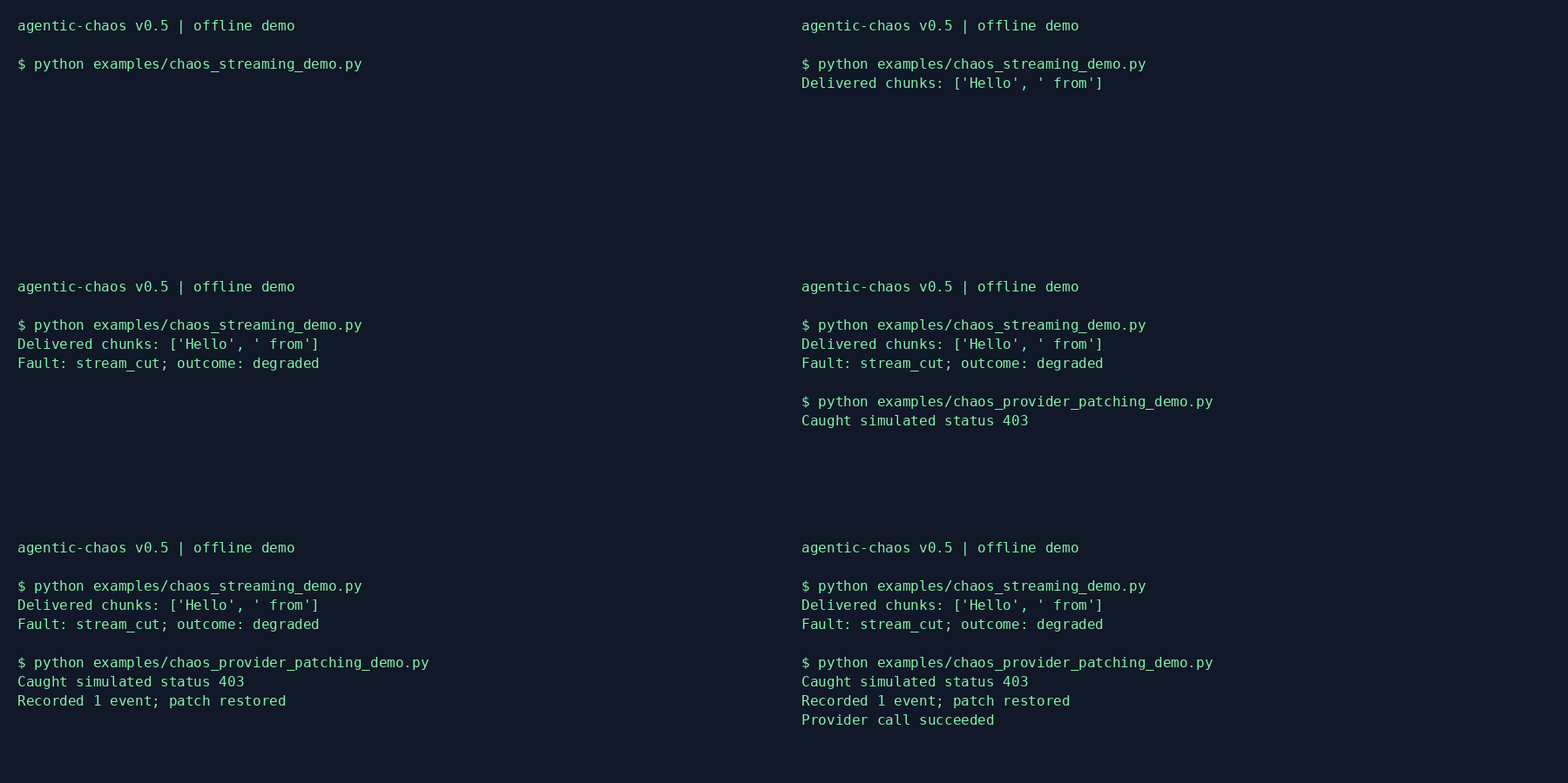
Run the offline examples with uv run python examples/chaos_streaming_demo.py
and uv run python examples/chaos_provider_patching_demo.py.
Safety rails ship in 0.5.2; see the safety guide.