v0.8: chaos workflows, declarative experiments and explosion radius
Available in 0.8.0. The core installation stays standalone. YAML experiment
files need the optional extra (pip install 'agentic-chaos[yaml]'). JSON and
TOML experiment files need nothing extra.
The offline examples need no provider and no network:
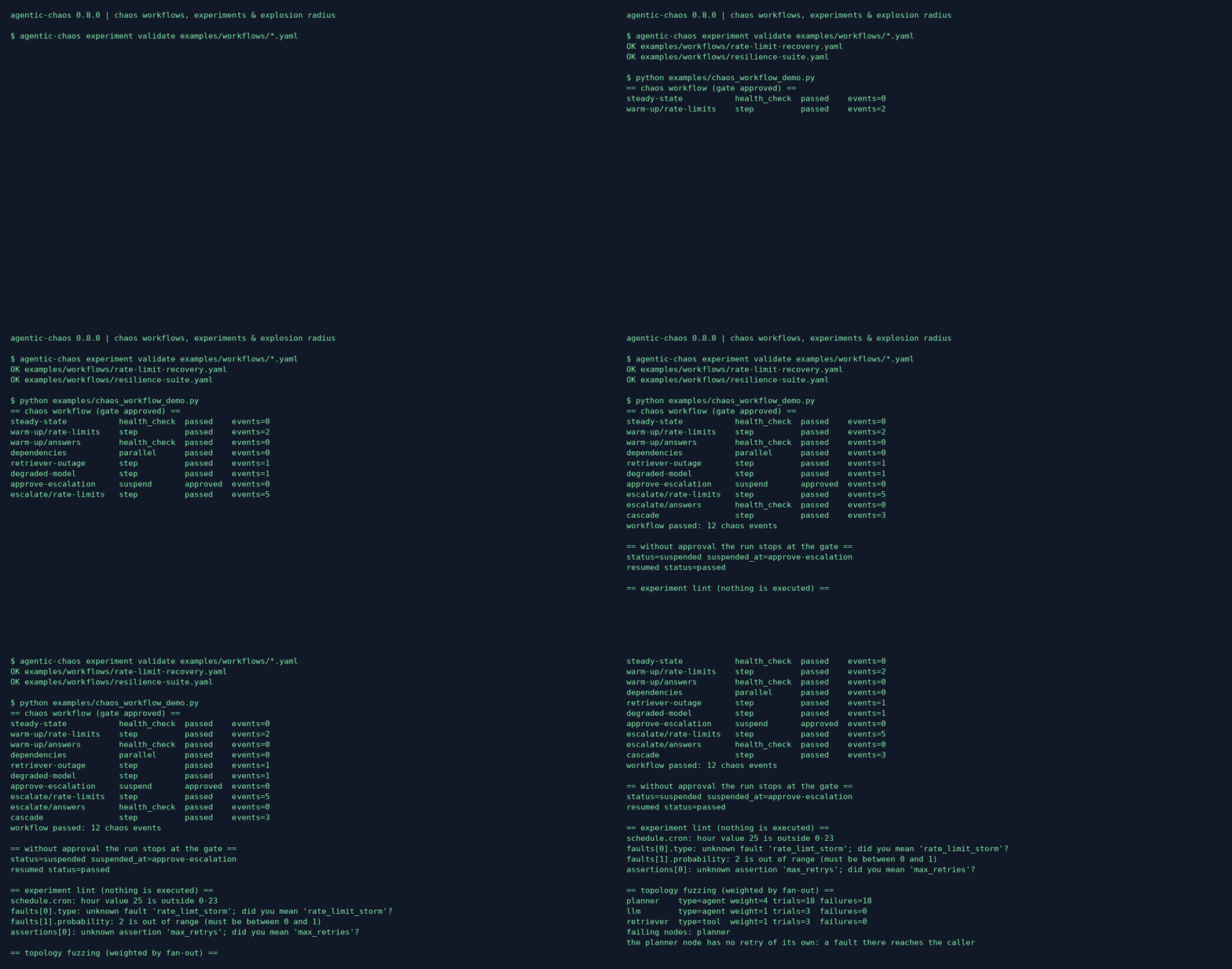
examples/chaos_workflow_demo.pyuses the Python API.examples/workflows/has a support agent and two experiment files.- The demo GIF is generated from their real output.
Explosion radius: Scope
A Scope limits where a fault is allowed to fire. Every built-in fault, and
cascade(), accepts scope=:
from agentic_chaos import RateLimitStormFault, Scope

RateLimitStormFault(
    burst_count=3,
    scope=Scope(
        steps=["retriever", "planner"],  # only these steps
        providers=["openai"],            # only OpenAI calls
        exclude_steps=["safety_check"],  # never this one
    ),
)
- Steps are matched against the
step_nameof a call.wrap_tool()andwrap_node()use the tool or node name asstep_name. - Providers are matched against
chaos_provider.patch_openai,patch_anthropicandpatch_googleset it for you. For direct calls, pass it yourself:chaos_call(fn, ..., chaos_provider="openai"). It is never forwarded tofn. - Exclusions always win.
exclude_stepsandexclude_providersoverride any inclusion. - Include lists fail closed. An unlabelled call is outside any scope that names steps or providers.
- Scope is checked before probability sampling. Out-of-scope calls don't consume random draws, burst counts or dry-run preview copies, and they don't appear in dry-run plans. A scoped run with a seed therefore draws exactly what an unscoped run would draw over only the in-scope calls.
- Cascades check their own scope and the scope of the pending stage.
- Profiles accept scopes too: add a
[profiles.NAME.parameters.FAULT.scope]table with the same four keys.
Custom faults that call BaseFault.__init__ get scoping automatically. Others
can set a scope attribute or override in_scope().
Chaos workflows
A workflow is a multi-stage campaign:
from agentic_chaos import RateLimitStormFault, Scope, TokenTimeoutFault, cascade
from agentic_chaos.workflows import (
    ChaosWorkflow, HealthCheck, Parallel, Step, Suspend, Template,
)

storm = Template("storm", lambda burst=2: [
    Step("rate-limits", faults=[RateLimitStormFault(burst_count=burst)]),
    HealthCheck(fn=my_agent, name="answers", expect_contains="Answer:"),
])

workflow = ChaosWorkflow("resilience-suite", steps=[
    HealthCheck(fn=my_agent, query="Are you working?"),
    storm.use(name="warm-up"),
    Parallel(Step("tools", faults=["tool_failure"]),
             Step("memory", faults=["memory_corruption"])),
    Suspend("approve-escalation", reason="the next stages are louder"),
    storm.use(name="escalate", burst=5),
    Step("full-blast", faults=[cascade(first=RateLimitStormFault(burst_count=2),
                                       then=TokenTimeoutFault(hang_seconds=1))]),
], scope=Scope(exclude_steps=["safety_check"]))

report = workflow.run(my_app, approve={"approve-escalation"})
Node types
| Node | Behavior |
|---|---|
Step(name, faults, *, target, repeat, contracts, breaker, dry_run, scope) |
Runs the target repeat times inside a fresh chaos_session. Fails when the target raises (or a script exits non-zero) or a contract doesn't pass. Reports aborted when its breaker trips. |
HealthCheck(fn, query, *, name, expect_success, expect_contains, expect, retries, retry_delay_seconds, halt_on_failure) |
A steady-state gate that runs with no chaos session active. With expect_success=False it passes only when the call raises. A failed check halts the workflow unless halt_on_failure=False. |
Parallel(*branches, name, max_workers) |
Runs each branch (a node or a list of nodes) in its own thread and its own empty context, so each branch has its own chaos session and topology tracker. Waits for every branch before the next node. |
Suspend(name, reason, approve) |
A human-in-the-loop gate. The approver returns True to continue, False to reject, or None (no decision yet) to stop the run as suspended. |
Template(name, build, **defaults) / .use(name, **params) |
A reusable node sequence. build is a callable, or a fixed list of nodes. Each use prefixes node names with its own name (escalate/rate-limits). |
Semantics
- Fresh fault instances. Faults are deep-copied every time a step runs. Running a workflow twice, or using a template twice, never shares burst counts, decay progress or random streams. Fault names are resolved to fresh instances.
- Stopping. By default, the first failing step stops the workflow.
stop_on_failure=Falsekeeps going, but the final status is stillfailed. Remaining nodes are reported asskipped, so a report always shows the full plan. - Workflow-level
scopeis intersected with every fault's scope, together with each step's ownscope. - Workflow-level
breakeris the default for steps without their own. Breaker state is per step, because each step is its own session. - Approving gates.
approve=takes a callable(gate, report_so_far) -> bool | None, a set of gate names, orTrue/False. A gate's ownapprovecallable takes precedence. - Resuming.
resume_from="gate"skips every node up to and including that top-level gate, which is treated as approved. Skipped nodes are reported asskippedand the gate asresumed. - Dry run.
dry_run=Truepreviews every step. Targets and health checks still execute, as with all Chaos previews. Suspends are reported aswould_suspendand don't stop the run. - Not allowed: running a workflow inside an active
chaos_session(), and putting aSuspendinside aParallelblock. - Names. Node names must be unique. Unnamed health checks and parallel
blocks are numbered (
health-check-1,parallel-1, ...).
Statuses
| Level | Statuses |
|---|---|
| Node | passed, failed, aborted, skipped, approved, rejected, suspended, resumed, would_suspend |
| Workflow | passed, failed, aborted, halted (a health check failed), rejected, suspended |
Reports
WorkflowReport (kind: chaos_workflow, schema_version: "1.0") holds:
- the result of every node, including parallel branches;
- each step's native
ChaosReportand contract results; - every step's events in a top-level
chaos_eventslist.
Each event gains detail.workflow = {id, name, step}. Because events sit at
the top level, a workflow report file loads wherever a ChaosReport or an
AgenticLens Workflow is read.
report.to_chaos_report() merges every step into one native report:
- events, plans, cost, injections and in-flight counts;
- call records, renumbered globally, each with a
workflow_step; - the first escaped error, and the first abort;
- topologies, unioned by node name;
- a
workflowsummary, a new optionalChaosReportfield.
Use the merged report with check_contracts() and to_aios_run(). The AIOS
export carries the workflow summary in the producer extension
(io.deepagentlabs.agentic-chaos). There is no core AIOS schema change.
Declarative experiments
Experiments separate the definition of a chaos test from its execution, so SREs and QA can write, review and version them next to the code.
Single-stage experiment
# examples/workflows/rate-limit-recovery.yaml
name: rate-limit-recovery
target: support_agent.py:handle # resolved relative to this file
faults:
  - type: rate_limit_storm
    burst_count: 3
    retry_after: 0
    scope: { steps: [llm], providers: [openai] }
assertions:
  - completes_within: 30
  - max_retries: { n: 5, step: llm }
  - recovered_after_failure: true
  - no_unhandled_error
safety: { max_injections: 20 }
schedule: { cron: "0 2 * * *", timezone: UTC }
Multi-stage workflow
Replace faults/assertions with a workflow: list of one-key nodes:
step, health_check, parallel, suspend and use. Reusable templates
take params defaults, and use: {template, name, with} overrides them. See
examples/workflows/resilience-suite.yaml.
In a template, a value that is exactly "${name}" is replaced by the
parameter and keeps its type, so burst_count: "${burst}" stays an integer.
Inside a longer string, the parameter is interpolated as text. Write $${
to get a literal ${.
Top-level fields
| Field | Meaning |
|---|---|
version |
Optional; 1 |
name |
Required |
description |
Optional text |
target |
app.py (a script run as __main__), app.py:function or package.module:function. Relative paths resolve against the experiment file. A file target's directory is put on sys.path, so the file can import modules next to it. |
faults |
Single-stage form only. A fault is a name, or a mapping with type, its constructor parameters and an optional scope. type: cascade takes first, then and delay_between. |
assertions |
Single-stage form only. Each item is a contract name, {contract: value} (the first parameter) or {contract: {param: value}}. |
repeat |
Single-stage form only. How many times to run the target. |
workflow |
The multi-stage form, a list of nodes. |
templates |
Reusable node sequences for use. |
scope |
Applies to every fault. |
safety |
Circuit-breaker limits: max_cost_usd, max_failure_rate, failure_window, min_calls, max_duration_seconds, max_injections. |
dry_run |
Default for runs |
stop_on_failure |
Default true |
schedule |
{cron, timezone}, or a cron string |
Validation (lint)
agentic-chaos experiment validate experiments/*.yaml # exits 0 or 1
Validation reports every problem it finds with its location, for example:
faults[0].type: unknown fault 'rate_limt_storm'; did you mean 'rate_limit_storm'?
faults[1].probability: 2 is out of range (must be between 0 and 1)
assertions[0]: unknown assertion 'max_retrys'; did you mean 'max_retries'?
schedule.cron: hour value 25 is outside 0-23
It checks:
- the schema shape and unknown fields;
- fault and assertion names, with suggestions;
- constructor parameters and their numeric ranges;
- parameters that only accept Python callables (such as
degrade_fn), which an experiment file can't set; - scopes, safety limits, cron fields and time zones;
- template parameters and recursive template use;
- duplicate node names;
- targets.
Targets are parsed, never executed. A file must exist, compile and define
the function at its top level. A module must be locatable with
importlib.util.find_spec, which imports the module's parent packages but
never the module itself. Pass --no-target-check to skip target checks, and
--base-dir DIR to resolve relative targets elsewhere.
Some findings are warnings rather than errors: templates that are never used,
and schedules that can never fire (such as February 31st). --strict makes
warnings fail too, and --json prints machine-readable results. Because
nothing is executed, this is safe as a pre-commit hook.
From Python, validate_experiment(path_or_document) returns the issues
without raising. load_experiment() raises ExperimentError, which lists
every issue.
Running
agentic-chaos experiment run experiments/resilience-suite.yaml \
  --approve approve-escalation --save workflow.json \
  --save-report merged.json --save-aios run.aios.json
agentic-chaos chaos workflow run experiments/resilience-suite.yaml   # same command
Every run validates the experiment first.
| Exit code | Meaning |
|---|---|
0 |
The workflow passed |
3 |
The run stopped at an unapproved Suspend |
1 |
Any other outcome: failed, halted, aborted or rejected |
After an exit 3, re-run with --resume-from GATE.
How gates are decided:
--approve NAME(repeatable) approves the named gate.--approve-allapproves every gate.- In an interactive terminal, any other gate prompts.
--no-inputnever prompts, so unapproved gates suspend the run.
The merged AIOS Run status is:
| Workflow | AIOS Run status |
|---|---|
passed |
completed |
suspended |
running (it can be resumed) |
| aborted | cancelled |
| anything else | failed |
Scheduling
agentic-chaos embeds no scheduler. experiment schedule previews the next
runs and prints an install snippet:
agentic-chaos experiment schedule experiments/resilience-suite.yaml --next 3
agentic-chaos experiment schedule experiments/resilience-suite.yaml --format github-actions
The cron parser supports:
- five fields, with
*, lists, ranges and steps; - month and weekday names, and
7as Sunday; @hourly,@daily,@weekly,@monthlyand@yearly;- Vixie-cron day-of-month or day-of-week matching when both are
restricted. As in Vixie cron, a day field that starts with
*(including*/2) counts as unrestricted.
Crontab output adds CRON_TZ for zones other than UTC. GitHub Actions
schedules always run in UTC; the snippet warns when the experiment names a
different zone.
examples/github-actions-chaos-workflow.yml
lints on every push and runs the suite nightly.
Topology fuzzer
fuzz_topology() explores rather than following a fixed plan:
from agentic_chaos import Scope
from agentic_chaos.workflows import fuzz_topology

report = fuzz_topology(my_graph, n=20, seed=0, scope=Scope(exclude_steps=["safety_check"]))
print(report.failing_nodes)
How it works:
- A fault-free baseline run discovers the topology: from the
TopologyTrackerthe target creates, or else from the step names it calls. You can passtopology=instead (a tracker, anAgentTopology, a report, or a path to one). - Each trial picks a node, weighted by 1 + its fan-out (the number of distinct nodes it sends to). Coordinators are therefore hit more often than leaf tools.
- The trial picks a fault suited to the node type, scopes it to exactly that node, and runs the target once.
The default faults per node type are in DEFAULT_FAULTS:
| Node type | Default faults |
|---|---|
| tool | tool_failure |
| memory | memory_corruption |
| agent or router | rate_limit_storm, silent_degradation |
| anything else | rate_limit_storm |
Pass faults= as a list, or as a {type: [...]} mapping, to choose your own.
A trial passes when all of these hold:
- the target returns;
recovered(output), if given, accepts the output;- every contract passes.
Node eligibility uses only the step parts of scope. Provider limits apply
when the node-scoped fault decides whether a call is in scope.
A trial whose fault never fires is reported as reached=False. That happens,
for example, when a node is only a caller label with no wrapped call site.
The same seed gives the same placements.
Targets must not pin faults=[...] at call sites to names outside the pool,
and must reset their own external state per run. fuzz_topology() complements
find_breaking_point(): one explores the whole graph, the other searches one
parameter.
From the CLI (exits 1 when a reached trial failed):
agentic-chaos agent fuzz my_graph.py --n 20 --seed 0 --exclude-step safety_check --save fuzz.json
Evidence and ecosystem compatibility
- Native evidence. Native event shapes and IDs are unchanged. Workflow
provenance (
detail.workflow) and theChaosReport.workflowsummary are additive, and older reports still load. - AgenticLens reads workflow reports and merged reports as
WorkflowJSON. - Control Tower counts merged native events.
- MCP exports merged reports with the workflow summary in the extension and discovers faults through the existing registry. Workflows and experiments are Python and CLI orchestration, not new MCP tools. Hosted HTTP still rejects script execution.
- AI Operations Specification. Merged exports validate against the AIOS v0.4 schema and semantic checker. The workflow summary is a producer-local extension, not a normative AIOS Workflow object.
- Agentic Evals keeps ownership of scores and release gates. Workflow statuses and contracts are per-run resilience checks.
- Agentic Sidecar 0.8.5 widens its optional extra to admit Chaos 0.8.
Health checks, workflow statuses and fuzz outcomes are resilience evidence. They don't prove containment: injecting into Sidecar/MCP gate, approval and evidence paths is still open roadmap work.